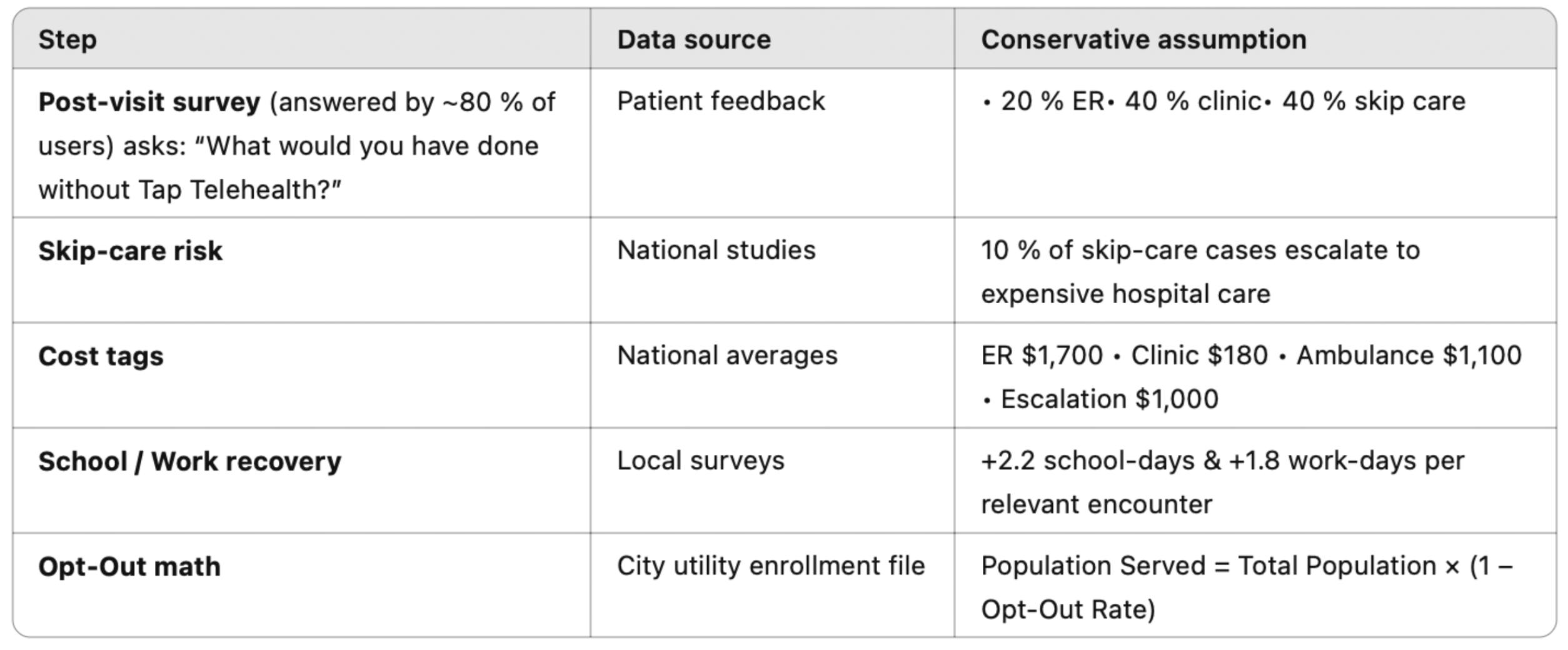
How we do the Math

The Bigger Picture

Tap Telehealth is not about steering patients away from local clinics; it’s about reaching the 20–30% of our community who had no practical option at all—the uninsured child with asthma, the senior without transport, the night-shift cook who can’t take off work. Every time those residents text us instead of watching a condition spiral, we protect their health, preserve family income, and keep high-acuity resources ready for true emergencies.

That’s why the dashboard’s dollar total is best read as “minimum savings.” The real win is healthier people, fewer medical bankruptcies, and a stronger, more resilient community.

Thank you for partnering with MD Health Pathways to make healthcare as accessible as water—available the moment someone reaches for their phone.

How to Read Your Community Dashboard

A healthier community isn’t built by counting dollars alone; it’s built by making sure every resident—grandparents, working parents, and kids alike—can reach a doctor when they need one.

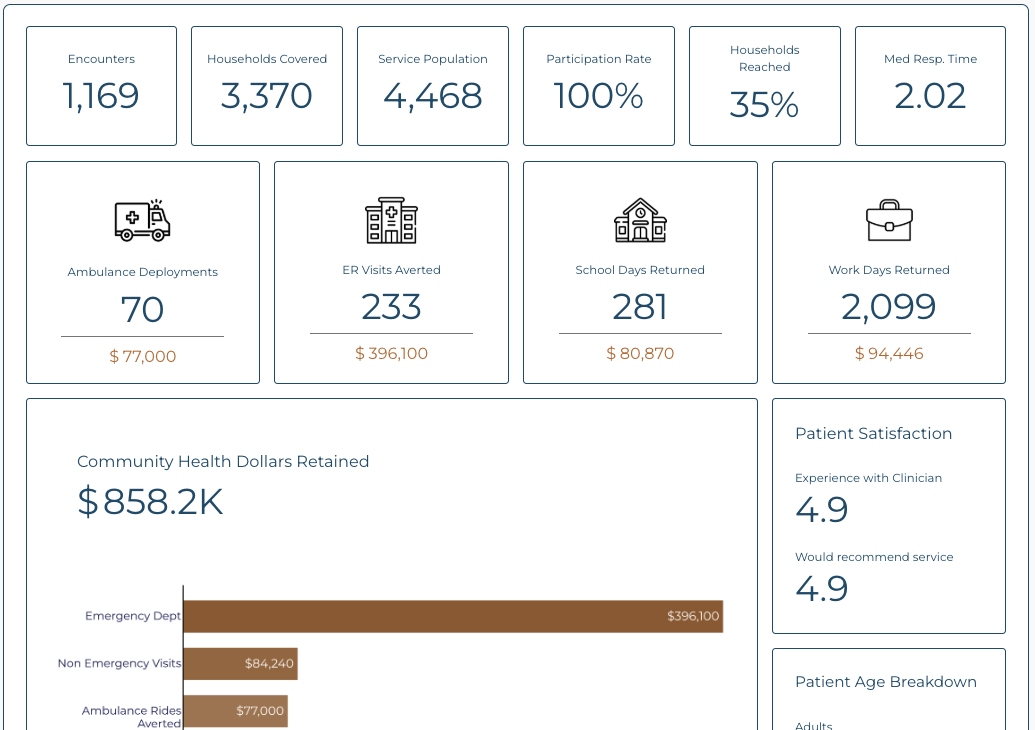
The dashboard you’re viewing turns thousands of text-message visits into a clear story of how quick, affordable care is closing gaps in our town’s health system.

What the top numbers mean

Total Encounters
The number of telehealth visits handled for your community during the selected time-frame. Every one of these cases was managed by a licensed provider—including an automatic 48-hour follow-up to make sure each patient is on track.

% Households Reached
The share of covered households that used Tap Telehealth at least once. A higher percentage means we’re reaching more families who actually need care.

Population Served
Residents still enrolled after opt-outs. This is not the city’s full census—it’s the slice of the community that chose to keep the service and can call or text us any time.

Median Response Time (min)
How quickly a provider replies after the first text. Consistently under 3 minutes shows we deliver on “Immediate Healthcare, Just a Tap Away.”

Opt-Out Rate
The percentage of households that chose to opt out. Opt-out is a built-in feature: if families feel well-served by their current doctors, they can bow out at any time—proof the program is truly voluntary.

ER Visits & Ambulance Deployments Averted
Direct relief for local hospitals and EMS. Each avoided ambulance keeps crews free for real emergencies.

The stacked bar turns each encounter into dollars the community didn’t have to spend on higher-cost care:

  1. Emergency Department – problems solved at home instead of a $1,700+ ER bill.

  2. Clinic Trips Saved – common issues handled virtually, saving travel and walk-in fees.

  3. Ambulance Rides Averted – residents without transport often dial 911 for non-emergencies; telehealth replaces that necessity.

  4. Complications Prevented – when someone would have skipped care altogether, 1 in 10 cases usually escalates to costly hospital treatment. Treating early avoids the crisis.

Potential Crises Averted – catching chronic issues (uncontrolled diabetes, hypertension, etc.) early can prevent long-term dialysis, stroke, or heart failure. This life-changing value isn’t fully priced in the bar, so the dollar total you see is a minimum estimate.

Two icons highlight time savings:

  • School Days Returned – Parents report kids get back in class about two days sooner thanks to same-day tele-care.

Work Days Returned – Adults avoid a full sick-day by texting or video-visiting instead of sitting in a waiting room. That’s real money and productivity kept in local households and businesses.

Patient Age Breakdown donut confirms both kids and adults use the service.

Encounters by Month chart lets you see adoption grow as more neighbors learn they can simply text a doctor.

Diabetes Program

Our approach to
diabetic care:

  • Proven glucose control and
    reduction of hemoglobin A1C
  • Accountability, individualized
    care management
  • Navigation including
    support groups, coaching,
    and education
  • Scheduled clinical testing
  • Access to and delivery
    of low-cost medication
  • Data tracking,
    analytics, and reporting

Public Health

Screening for disease/conditions,
including but not limited to:


• Influenza, COVID-19, Zika, Ebola
• Tuberculosis
• STDs
• Strep
• UTI, Pregnancy
• HIV/AIDS, Syphilis
• Hypertension
• Diabetes


Treatment for
communicable diseases:


• COVID-19
• Tuberculosis
• STDs
• Influenza
• Strep
• UTI


Preventative programs
and services:


• Childhood and adult immunizations


Epidemiology:


• Surveillance
• Tracking and
supporting outbreaks
• Disease reporting